Mobilising the academic study of organisations
Why academic disciplines analyse institutions brilliantly but rarely help design them — and what a more useful synthesis could look like.
Explorations of insights, questions, and experiments that inspire and spark our imagination when it comes to designing institutions for the 21st century.
Why academic disciplines analyse institutions brilliantly but rarely help design them — and what a more useful synthesis could look like.
TIAL’s working paper, after examining the governance structures of several real-life cases, explores a new logic for emergencies, the stack architecture. The stack is both diagnostic and descriptive and it helps the city leader know in real time where more effort should be placed in governing an emergency.
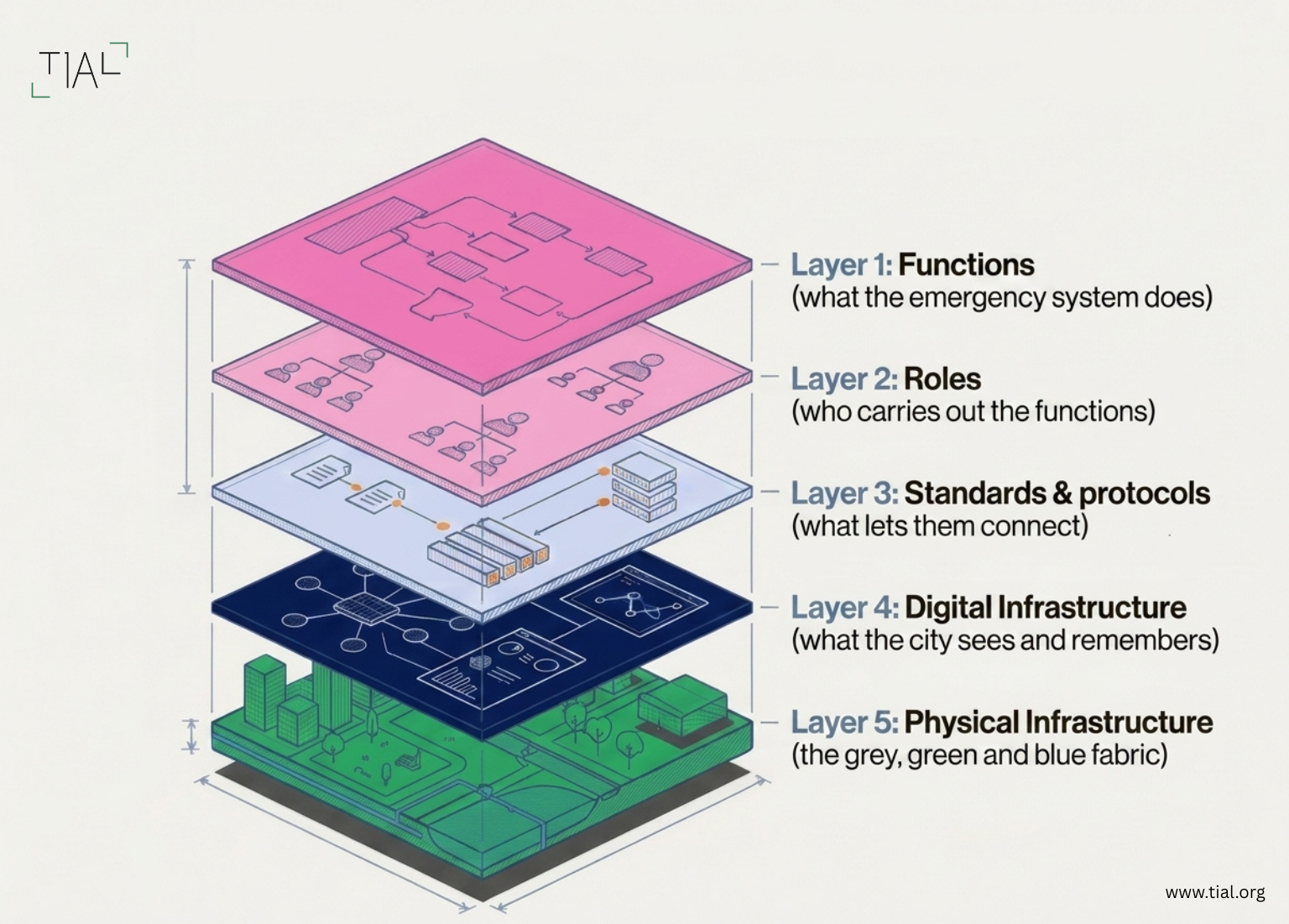
Stack thinking reframes how complex systems can be organised. Borrowed from computing, a stack is a layered architecture in which each layer performs a distinct function and interacts with others through defined interfaces.
Stack thinking: Options for reshaping the DNA of governments Read more
That is how governments avoid being trapped in the “eternal present”, even when the news cycle is determined to become the unofficial minister for everything.

How to imagine and build institutions for city governments across the world.

This paper proposes a new institutional architecture framework — the Interchange — to address complex, evolving governance challenges like climate change, artificial intelligence, and public health crises.
Instead of designing top-down systems, institutions should create conditions in which small groups can build minimal, working standards that others can adopt.
White paper #003: Emergent standards: Enabling collaborations across institutions Read more
This report outlines approaches for rethinking institutions for an era of demographic shifts in Finland. It is the result of a partnership with the Finnish Innovation Fund, Sitra.
Rethinking institutions in an era of demographic transition Read more
DOGE Done Better, a new paper written by TIAL’s Geoff Mulgan and published by Demos (UK), offers a model for redesigning government that balances efficiency with intelligence, legitimacy, and long-term purpose.
DOGE done better? The case for progressive efficiency and a streamlined state Read more
This white paper proposes a Well-Architected Framework for Public Procurement, inspired by software architecture, to make procurement more adaptive, responsive, and purpose-driven.
White paper #002: A Well-Architected Framework for public procurement Read more