Stack thinking offers an alternative institutional architecture
Stack thinking reframes how complex systems can be organised. Borrowed from computing, a stack is a layered architecture in which each layer performs a distinct function and interacts with others through defined interfaces.
The key shift is conceptual. Instead of organising around departments, systems are organised around functions and layers. Each layer can evolve independently, while still contributing to a coherent whole.
The Internet provides the clearest example. It is not governed by a single hierarchy, but by protocols that allow different layers to interoperate. Innovation can occur at one layer without disrupting others. This structure has supported both decentralised creativity and system-wide coordination.
Applied to government, stack thinking suggests a different model of institutional design:
- Core capabilities such as identity, payments, data management, and regulation can be developed as shared layers.
- Services can assemble these layers as needed, rather than building everything from scratch.
- Human expertise remains central, but is supported by modular digital and organisational components.
The publication describes this as a shift towards “government DNA”. A small set of standardised elements can be recombined in many ways, much like biological building blocks.
This approach also introduces the idea of composability. Institutions do not just operate components; they assemble and reassemble them to meet specific needs. This becomes a core capability in its own right.
Practical implications
Stack thinking changes how governments design, build, and govern systems.
First, it requires standardisation. Shared protocols and components must be agreed and maintained. This introduces a degree of central coordination, but for a specific purpose to allow more flexible decentralised use.
Second, it shifts skills and roles. Civil servants need to become adept at composing systems, not just managing departments. This involves combining data, tools, and human judgment into workable arrangements.
Third, it alters the economics of government. Shared layers reduce duplication and make it easier to update systems incrementally. They also reduce dependency on proprietary solutions, improving transparency and control.
Fourth, it opens new possibilities for policy domains. The publication points to examples such as emergency response, regulation, education, and social care. In each case, functions can be broken into layers that combine standardised elements with context-specific judgement.
Finally, it introduces new governance challenges. Composability requires oversight. Modular systems can fragment accountability if not carefully designed. And the integration of AI into these stacks raises questions about control, bias, and decision-making authority.
Toward strength without weight
Stack thinking does not replace all existing forms. Hierarchies, networks, and other organisational models still have a role. The argument is not for a single model, but for expanding the repertoire of institutional design.
What stack thinking offers is a way to reconcile two pressures that governments often treat as opposites: the need for coordination and the need for flexibility.
By separating layers and defining how they interact, governments can build systems that are both structured and adaptable. The ambition is what the publication calls “strength without weight”: institutions that can act decisively without becoming rigid.
The broader implication is that institutional architecture is a design choice, not a given. Governments are not bound to inherited structures. They can choose to organise differently, if they are willing to rethink the underlying logic.
That shift may be less about technology than about mindset. After decades of digital change, the more surprising fact is how little the core architecture of government has moved.
Explore our publications
Mobilising the academic study of organisations
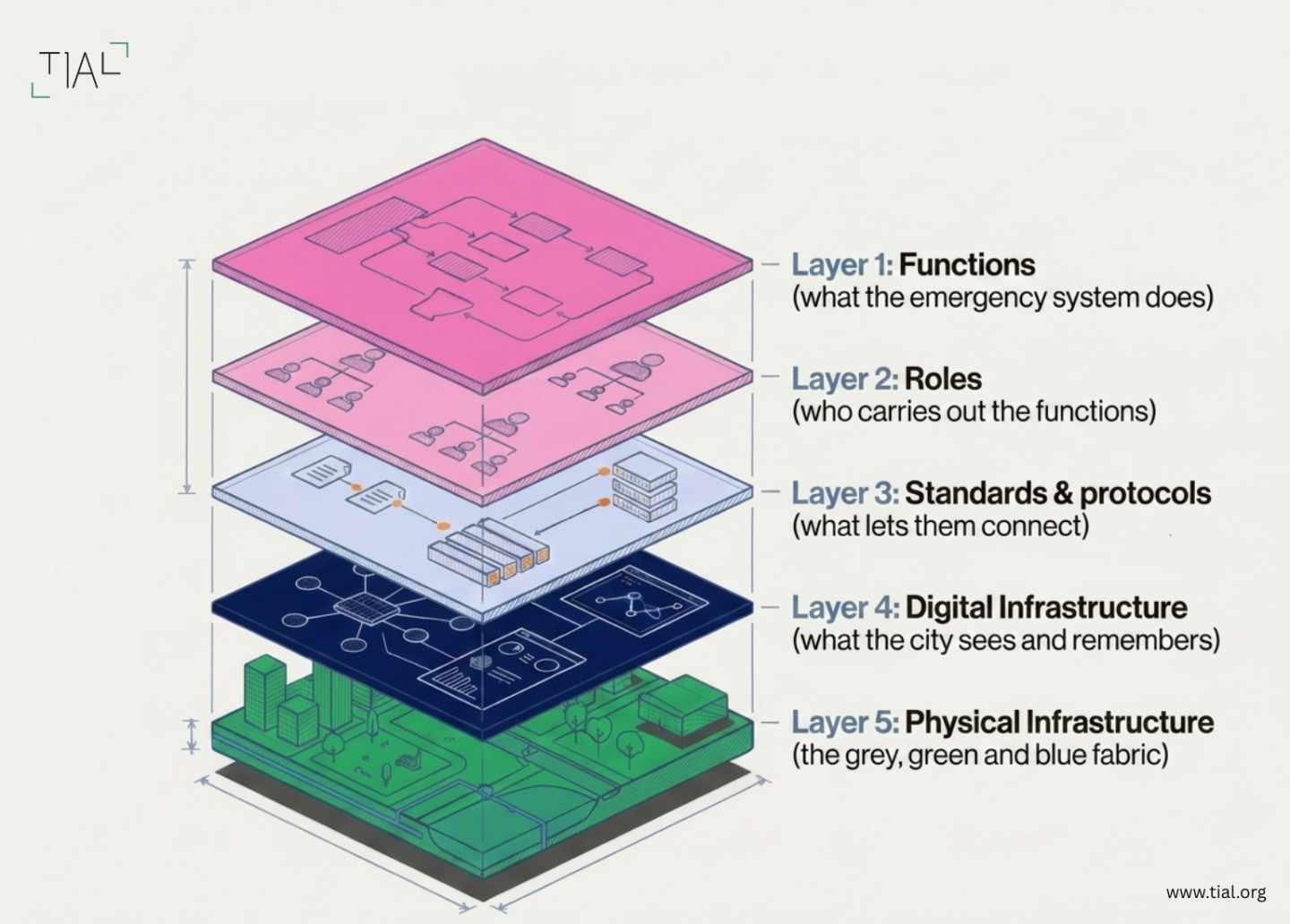
Working Paper: The Emergency Stack
Stack thinking: Options for reshaping the DNA of governments

Governing in turbulent times

Working Paper: The city as mesh