

From Istanbul to Belém, from the Amazon to Harvard: what building a field in institutional design looks like
What our work means in 2026
The question of whether our institutions can be (re)designed for this era is especially pertinent when the old paradigm is compromised. For TIAL, the return to what we’ve known is not an option. The only option is moving forward. As the future is uncertain it is also uncomfortable. Yet, we are here to continuously build clarity as we go, together, just like the creative bureaucrats of previous pivotal moments in history did.
TIAL is now in its third year of life. In that time, the work has reached UNDP’s Istanbul Innovation Days, the Rockefeller Foundation’s Bellagio Center, COP30 in Belém, and a symposium on cities at Harvard with the Bloomberg Center for Cities. For an organisation of that age, the rooms it has entered typically require a considerably longer bibliography.
That access reflects genuine backing from partners including the Rockefeller Foundation, UNDP, the Nordic Council of Ministers, Sitra and Bloomberg Philanthropies, among others. It also reflects real demand from practitioners and policymakers carrying mandates for which the existing institutional toolkit is no longer adequate. TIAL is still young as an organisation, and the field of institutional design is still forming, but both are gaining ground.
Mapping what is actually being tried
The most persistent gap in institutional innovation is not a lack of ambition but the absence of a shared, concrete catalogue of what governments are actually doing differently. Practitioners need to draw on real cases when facing design problems with no established answer. Two moments from the past year contributed directly to building that catalogue.
In March 2025, TIAL and Demos Helsinki joined UNDP at Istanbul Innovation Days. The partnership brought institutional innovation to one of UNDP’s flagship global platforms, drawing policymakers, development practitioners, and public innovators from across the world. The central question was how to move from identifying institutional failure to designing and building something better.
In January 2026, TIAL co-organised the Symposium on Institutional Innovation in Cities at Harvard with the Bloomberg Center for Cities. The symposium examined how cities should organise for tasks that cut across departments, mandates, and professions. TIAL’s central provocation was that cities function better as a mesh than as a pyramid. Cases from Barcelona, Manchester, Fortaleza, Atlanta, Bogotá, Bologna, and Rio illustrated what this looks like in practice. Neighbourhood-based care and climate centres, digital coordination structures, and new cross-city coalitions all featured in the mapping. No single model emerged as definitive. The conversations produced something more useful: a richer, more concrete sense of what is actually being tried, and why.
That accumulation of cases helps us imagine the next generation of institutions, their emerging properties, and their temporal possibilities.
Present where the problems are being lived
Alongside the catalogue work, TIAL spent the year in spaces where institutional problems are not theorised but managed, often under pressure.
At the Creative Bureaucracy Festival in Berlin in June, TIAL joined Demos Helsinki and Transition Collective for a live conversation with civil servants from across Europe. The session examined real experiments in institutional reinvention, from housing and climate adaptation to AI governance. The Festival treats reforming public institutions as genuine intellectual work. Such framing is rarer than it should be.
In October, TIAL went to Brazil for Innovation Week 2025 at ENAP, Brazil’s National School of Public Administration, in Brasília. The workshop on institutional imagination used design exercises drawn from natural systems. Participants sketched governance models suited to rapid ecological change: solid without rigidity, adaptive without losing direction. We are so grateful to the practitioners who were present — people carrying real mandates, working through questions with no established answers.
Being present in those spaces is the true and collaborative effort of building a field. The value lies in practising together rather than the more typical from-theory-to-practice approach. We are developing the theory and practice alongside each other.
From problem statement to real-life demonstration
One strand of TIAL’s work has traced a longer and more demanding arc. The challenge runs from identifying a governance gap, through designing a response, toward building something real.
The arc begins at the Rockefeller Foundation’s Bellagio Center in February 2025. TIAL convened a group of scientists, policy practitioners, and institutional leaders to examine how current governance systems are equipped to deal with nonlinear climate risks. The discussion focused on where existing institutions fall short in recognising and responding to tipping dynamics, and on the capabilities needed to bridge this gap. The Bellagio gathering helped establish a shared understanding of the problem and positioned tipping-point governance as an institutional design challenge that would guide the work that followed.
From Bellagio, the work moved to Rio de Janeiro in July. TIAL and CEBRI, the Brazilian Centre for International Relations, hosted the Amazon Interchange, introducing a new concept in institutional architecture. The Interchange is a framework for connecting ecological science to governance, giving decision-makers a way to act on Earth system change before windows close.
In November, the work arrived at COP30 in Belém. Our session brought together Rolf Rodven, Executive Secretary of the Arctic Monitoring and Assessment Programme (AMAP); Marielos Peña-Claros, Co-chair of the Science Panel for the Amazon; and Arunabha Ghosh, South Asia Special Envoy to COP30. The conversation centred on Tipping Element Monitoring and Response Facilities: a proposed global network for monitoring and responding to planetary tipping points. These include ocean circulation shifts and rainforest collapse, processes that are irreversible once begun. These institutional forms do not yet exist. The session was about what it would take to build them.
TIAL is now working to initiate a practitioner cohort through the 17 Rooms process to carry this into its next phase. It will be a short, structured process that brings practitioners together to work through a problem and identify where practical action can begin. The focus is on identifying a few concrete starting points for regional experimentation and working with partners to develop them over time, including pathways that could evolve into TEMRF-like arrangements.
Moving from diagnosis to design to organised collective action is how TIAL wants to show possibility. The climate governance strand is attempting that full movement.
What comes next
In June 2026, TIAL will partner with Transition Collective and Demos Helsinki for a Master Class on institutionalising for impact in Copenhagen. The Master Class runs alongside the Organising for Uncertain Worlds global conference at the same venue. Planning is also underway for a series of workshops focused on urban challenges, like shaping institutions for emergencies or redesigning care systems in aging cities.
An invitation
The work described here was possible because partners created the conditions for it and practitioners showed up to use it. If these questions overlap with your work, whether in government, philanthropy, civil society, or research, we would like to hear from you.
Read more from us
Mobilising the academic study of organisations
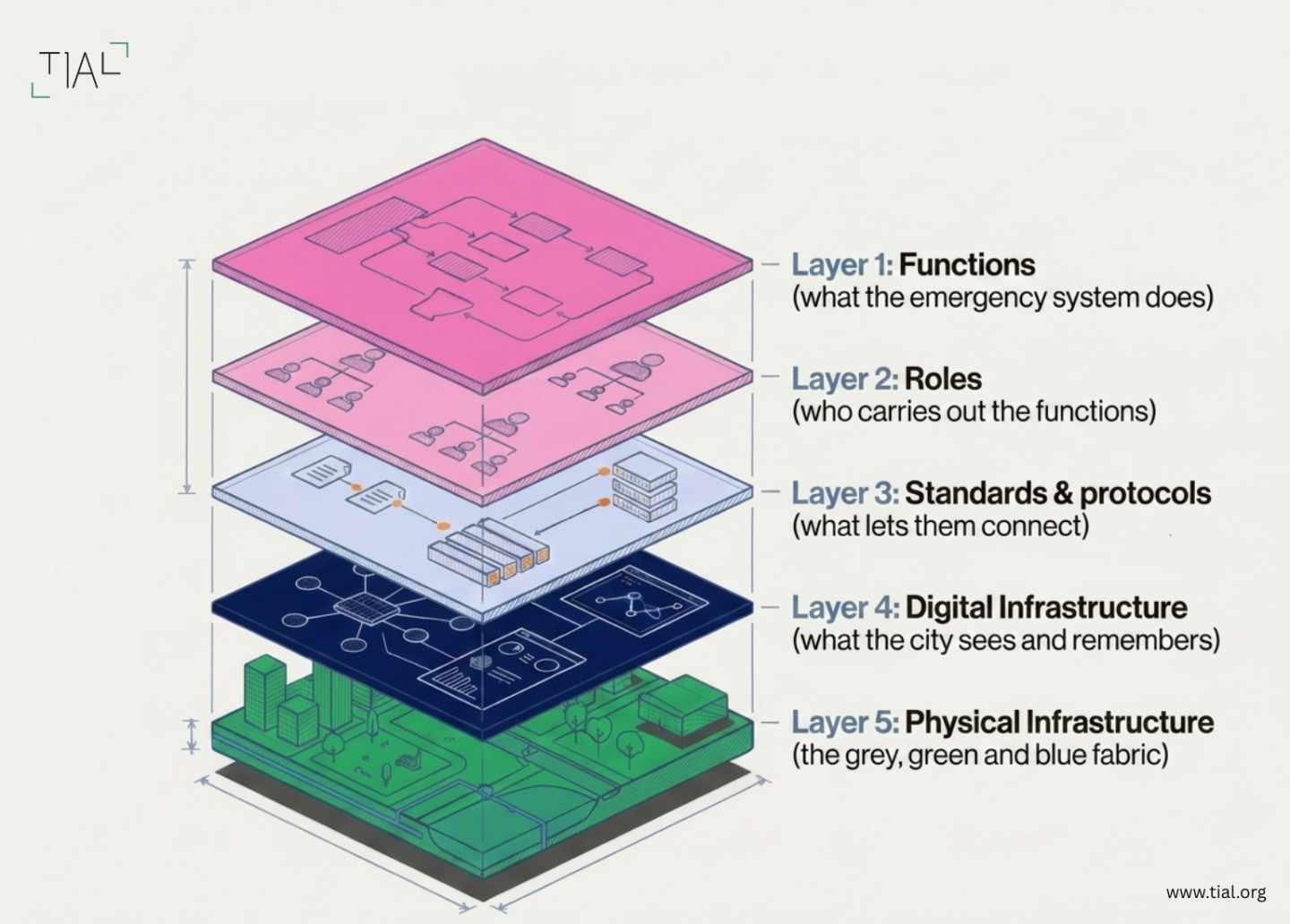
Working Paper: The Emergency Stack
Stack thinking: Options for reshaping the DNA of governments

Field work: Reflections on TIAL’s second year

Governing in turbulent times

Working Paper: The city as mesh
Featured image: Steve A Johnson / Pexels
