A dossier mapping how cities organise for emergencies — and proposing a new design tool for city leaders
Emergencies have always been part of city life, but their frequency has changed. Climate instability, cyberattacks, and the interconnected nature of modern infrastructure have pushed events that were once exceptional into something closer to routine. Cities are responding, but the institutions many of them are relying on were designed for a different era.
How well are cities actually organised to handle emergencies? What would it take to do better?
What the research covers
TIAL examined emergency governance across cities in Brazil, India, the United States, South Africa, New Zealand, Tanzania, the Philippines, and elsewhere. Rather than ranking cities or declaring winners, the research traces the institutional forms that have emerged in practice: operations centres, permanent agencies, task forces, and community-based arrangements. Each form has strengths. Each has characteristic failure modes.
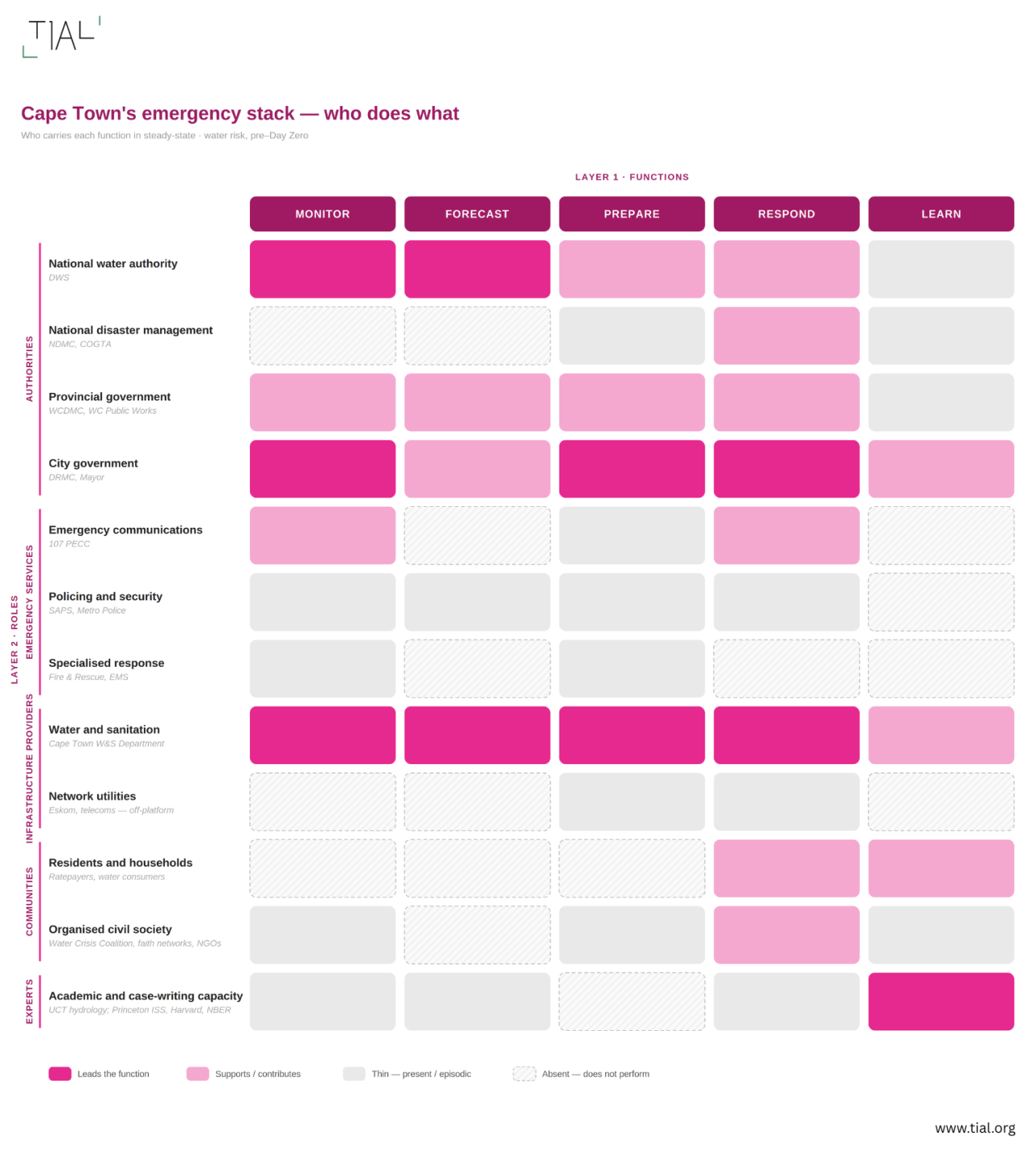
Rio de Janeiro’s Centre for Operations and Resilience (COR) brings over 30 city departments into a single coordinating space, drawing on sensors, dashboards, and real-time data. Seoul has been deploying AI-powered callbots to cluster and prioritise incoming emergency reports, shortening the time between signal and response. Mexico City rebuilt its emergency secretariat after two major earthquakes — in 1985 and again in 2017 — and now coordinates a city-wide system that includes neighbourhood volunteers, research institutions, and autonomous bodies. Cape Town assembled a temporary Water Crisis Management Committee in 2018, ran the city through its near-catastrophic Day Zero scenario, and then dissolved the committee once its mandate was met. Porto Alegre created a comparable body after historic floods in 2024 — and then kept extending it, as reconstruction turned into climate adaptation governance.
These are not stories of failure. They are stories of institutions learning under pressure, which is harder than it sounds and rarer than it should be.
The emergency stack as a design tool
The dossier introduces the emergency stack as a framework for understanding how emergency systems hold up or fail to.
The concept borrows from technology: a stack is a layered architecture where each component has a distinct function, and the whole only performs when the parts connect.
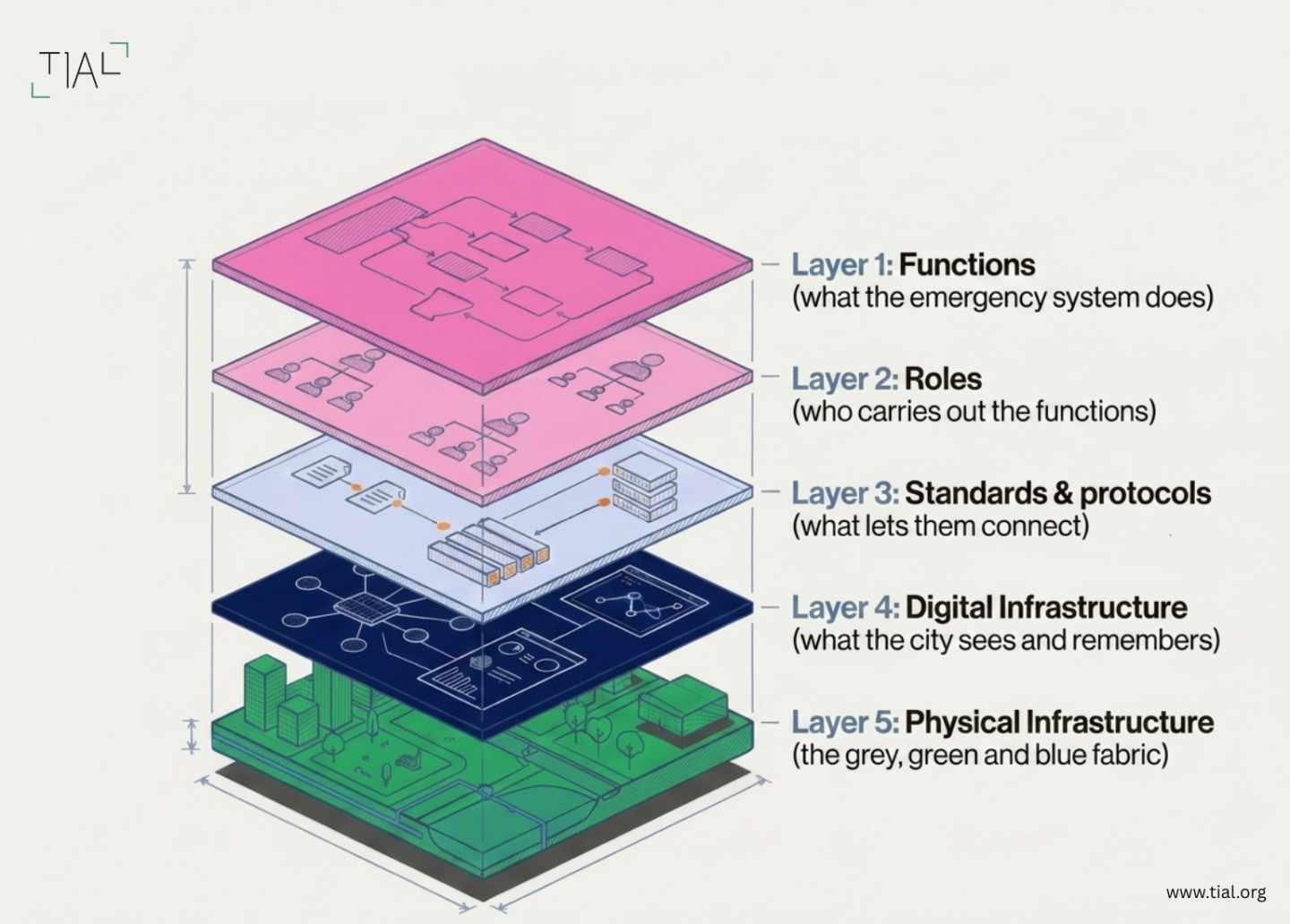
Applied to city governance, the stack has five layers.
The first describes what an emergency system must do: monitor risks, forecast extremes, prepare the institutional and social conditions for response, respond under pressure, and learn from what happened.
The second describes who carries those functions, separating authorities, emergency services, infrastructure providers, communities, and expert networks.
Neither layer works without the third: the shared standards and protocols that allow different organisations to act on a common understanding of what a warning means, or when to escalate.
Two further layers shape what is possible in practice. Digital infrastructure — data systems, communications platforms, the AI tools now appearing in Seoul and elsewhere — determines what the system can see and when. Physical infrastructure, the drainage networks, green corridors, and flood defences that absorb or redirect hazards, determines how much damage reaches the response layer in the first place.
The stack’s value is diagnostic as much as descriptive. It moves a city leader past the general sense that capacity is lacking and towards something specific: which layer is thin, which interfaces between roles are broken, which standards are missing or untested. A vague feeling of unreadiness becomes a map of where the gaps sit.
What the cases reveal
Several patterns emerge across otherwise very different cities:
Permanent institutions retain knowledge better than temporary ones, but they are slower to adapt when risks shift. Task forces move fast and concentrate authority, but they struggle to preserve what they have built when their mandate ends — unless someone has designed the closing phase with the same care as the opening. Community-based structures, from Tokyo’s bosai neighbourhood networks to Brazil’s NUDECs in Petrópolis, reach places that centralised operations centres cannot, and detect signals that dashboards don’t highlight.
Insurance is a largely invisible layer of the emergency stack. Houston’s experience after Hurricane Harvey shows what can happen: roughly three-quarters of the county’s homes carried no flood protection at all, leaving city government to absorb the residual burden of a financial system that had already priced itself out of the places most at risk. France’s CatNat scheme, a mandatory national surcharge pooled across all property insurance, shows that different choices are available — and that the design of financial preparation is a policy decision, not a market inevitability.
The spatial and temporal dimensions of emergency governance matter more than institutional charts suggest. Knowledge moves through social networks, not just through reporting lines. The people who worked the last emergency are the ones most likely to make the next response work — which means institutions need deliberate mechanisms to retain and transfer what they know.
Who this is for
The dossier is written for city leaders, practitioners, and researchers who want to understand what current practice looks like across the world and explore what different arrangements might be possible. The stack is offered not as a model to implement but as a shared language: a way for city teams to name what they have, identify what is missing, and design with more precision than organisational charts allow.
Mobilising the academic study of organisations
Working Paper: The Emergency Stack
Stack thinking: Options for reshaping the DNA of governments

Field work: Reflections on TIAL’s second year

Governing in turbulent times