What can the academy actually tell us about building the institutions we need? Less than it should.
There is no shortage of brilliant work on how organisations behave. Economists trace how incentives shape institutional failure long before scandal does. Lawyers know that a vague mandate invites mission creep, while too narrow a one prevents adaptation. Anthropologists, following scholars like David Graeber, have shown that the official version of an institution and the version experienced by the person queuing inside it are often two different buildings entirely.
The trouble is that each discipline tends to describe the same animal without realising the others are touching it too. It is the old parable of the blind men and the elephant, retold across a dozen university departments: one insists it is a market, another a hierarchy, a third a culture, a fourth a constitutional order. Few step back to ask what the whole creature looks like, and fewer still ask how to build a better one.
Diagnosis is abundant. Design is scarce.
This publication surveys twelve disciplines — from psychology to political science, design to complexity theory — for what they offer someone tasked with creating a new institution rather than merely explaining an old one. The pattern that emerges is consistent: a strong bias towards analysis over design, and towards diagnosing the past over building for the present.
Some of the most useful insights are the most practical. Elinor Ostrom showed that communities can govern shared resources effectively without either market or state, so long as rules are made and enforced locally. James C. Scott’s mētis — the unglamorous, hard-won knowledge that lives in communities rather than manuals — explains why institutions imported wholesale from elsewhere routinely collapse on contact with reality. Administrative law’s quieter virtues, like the duty to give reasons and the right to a fair hearing, are not red tape; they are load-bearing walls. Strip them out at the design stage and the whole structure becomes prone to litigation, distrust, and slow collapse.
Design thinking offers something rarer still: permission to fail cheaply, on purpose, before committing to anything permanent. Prototyping treats early mistakes as useful information rather than embarrassments to be hidden, a habit the more cautious traditions of public administration have only half-learned.
A more interesting frame is already within reach.
The richest possibilities lie at the joins between disciplines, where almost nobody currently works. Seeing organisations as something closer to living systems — with metabolisms, lifecycles, and inherited traits from earlier organisational forms — opens up entirely different design questions than treating them as machines to be engineered. So does taking seriously the fact that institutions exist in ecosystems: competing, cooperating, and shaping the very organisations that compete against them, in ways no single discipline currently tracks well.
There is also a timing problem hiding in plain sight. Some institutions need to last for centuries; others should be allowed to be brief and bright. The mismatch between an operating environment that moves in months and institutions designed to move in decades is now one of the most visible failures in public life, and barely anyone is building theory to address it directly.
An invitation, not a verdict.
None of this is a complaint that the disciplines have nothing to offer. It is closer to the opposite: there is more raw material for institutional design scattered across the academy than is currently being used, and the obstacle is mostly a failure of conversation, not of insight. The people who study power, behaviour, code, culture and complexity already hold most of the pieces. What is missing is a shared table to put them on.
The questions this publication leaves open are addressed to anyone working in these fields: how is your discipline learning from the others, and what would it take to turn what you know about how institutions work into something that helps build the next one?
A first version of this paper was published on Geoff’s Substack.
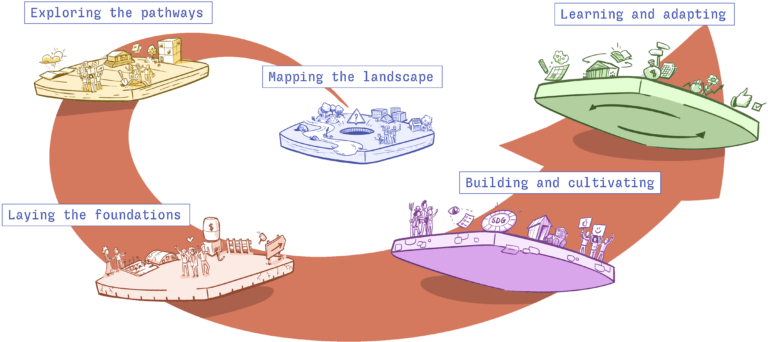
Playbook: Designing new institutions and renewing existing ones
Rethinking institutions in an era of demographic transition

The “Interchange” project: Toward an institutional architecture for representing, recognising, and responding to tipping elements
Stack thinking: Options for reshaping the DNA of governments
Governing in turbulent times

New approaches to anticipatory regulation: the Regulatory Innovation Office (RIO) in the UK and the new AI regulators

Artificial Intelligence and tackling the challenge of designing new public institutions

Part 1: What is institutional architecture anyway?
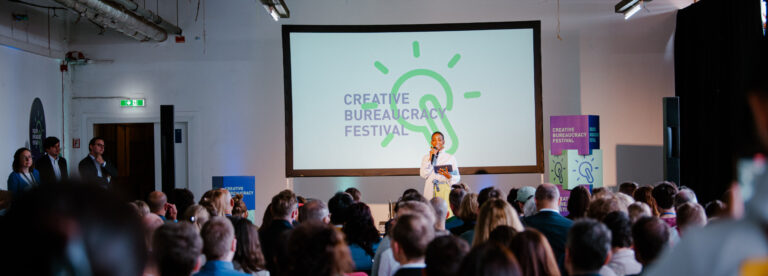
Reimagining public institutions: A time for bold experiments

Introducing “Reimagining Public Institutions”: a community for institutional architects